Apps

Google Bans 80,000 Developer Accounts, Blocks 1.75M Harmful Apps in 2025

Published

on

Google enhances Android security in 2025, blocking 1.75M harmful apps and banning 80,000 malicious developer accounts using AI-driven real-time protections.

Google has pulled back the curtain on its latest efforts to fortify the Android ecosystem , revealing a strategy heavily reliant on AI-driven protections and rigorous policy enforcement . The tech giant is expanding its real-time defenses to shield users from an increasingly complex landscape of malware, fraud, and privacy intrusions .

#Google

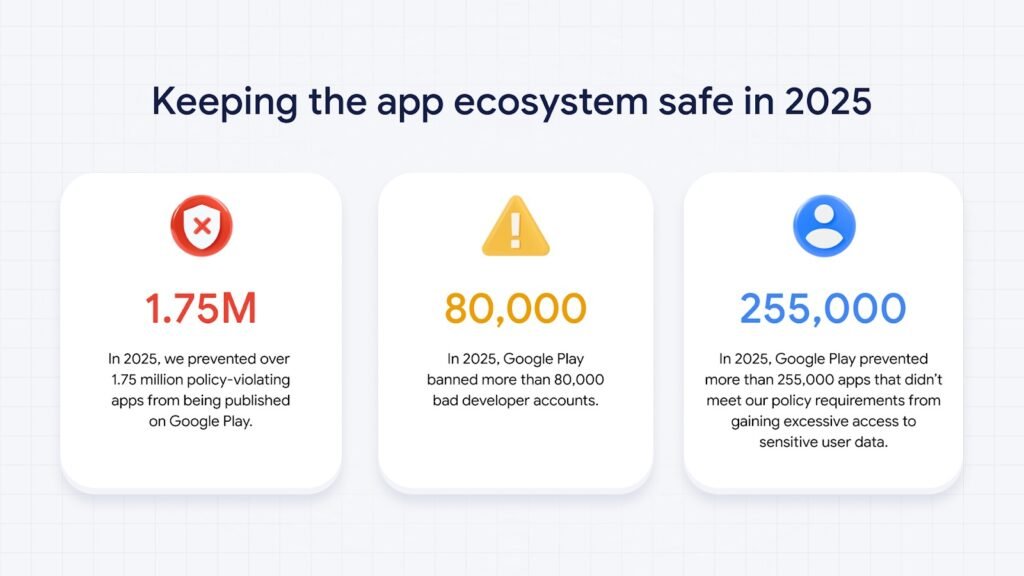
The numbers from 2025 illustrate the scale of this crackdown . Google intercepted more than 1.75 million policy-violating apps before they could ever reach the Google Play Store . Simultaneously, the company purged over 80,000 developer accounts associated with malicious activity . Google notes that by enforcing stricter verification protocols and mandatory pre-review checks , it has significantly raised the barrier for bad actors while streamlining the process for legitimate developers to build compliant software .

Getting an app listed is no longer a simple checkbox exercise . Every submission now undergoes a gauntlet of over 10,000 safety checks before publication , followed by continuous post-release monitoring . Throughout 2025, Google supercharged this process by integrating its latest generative AI models , equipping human reviewers with the tools to identify complex, malicious patterns with greater speed and accuracy .

Privacy remains a cornerstone of the companyโ€™s defensive strategy . By tightening its policies, Google blocked more than 255,000 apps that attempted to grab unnecessary access to sensitive user data . Furthermore, tools like the Data Safety section and Play Policy Insights in Android Studio have helped developers navigate these requirements, allowing them to reduce permission requests early in the build process .

Integrity extends to user feedback as well . To preserve the reliability of app ratings , Google intercepted 160 million spam reviews, effectively neutralizing attempts to artificially inflate or crash scores . According to the company, these interventions prevented an average 0.5-star drop for apps targeted by coordinated โ€œreview bombingโ€ campaigns .

Google Play Protect continues to serve as the heavy lifter in Androidโ€™s defense architecture . Scanning over 350 billion apps dailyโ€”including those sideloaded from outside the store โ€”the systemโ€™s real-time capabilities flagged over 27 million new malicious apps from external sources in 2025 alone . Fraud protection has also expanded significantly, now covering 2.8 billion devices across 185 markets . This layer alone blocked 266 million risky installation attempts tied to 872,000 high-risk apps . Additionally, a new in-call scam protection feature now prevents users from being tricked into disabling Play Protect during suspicious phone calls .

On the technical front, the Play Integrity API has been upgraded to support hardware-backed signals and โ€œdevice recallโ€ tools to spot repeat offenders. Android 16 is also stepping up with built-in tapjacking protection , a feature developers can now enable with minimal coding effort .

Looking ahead , Google has signaled that its investment in AI defenses and rigorous verification programs will only increase, aiming to solidify trust across the entire Android ecosystem .

Leave a Reply

Your email address will not be published. Required fields are marked *

Trending

ยฉ Copyright 2026 | All rights reserved | Technews89.com