
Tablet
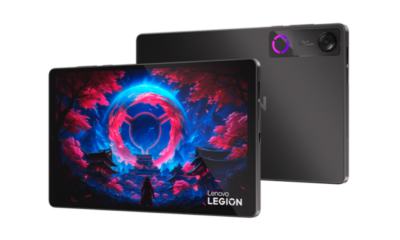
Lenovo is slowly pulling back the curtain 🎭 on the upcoming Legion Y700 (2026) 📱,


Lenovo reveals the Legion Y700 (2026) gaming tablet, featuring a 165Hz 3K display. Discover the logic behind the jump to ultra-high refresh rates for mobile gaming.
Lenovo is slowly pulling back the curtain 🎭 on the upcoming Legion Y700 (2026) 📱, and the standout spec so far is undoubtedly that 165Hz display ⚡. It’s a bold move, and it naturally raises a fair question: does a tablet—even one built for gaming 🎮—actually need to go that high? Lenovo recently took to Weibo to explain the logic behind the jump from the standard 120Hz. 🚀
On paper, the screen is already a beast 👹. We’re looking at a 3K resolution (3040 x 1904) with a pixel density of 409ppi 💎. That’s high-end territory by any standard. But the refresh rate is where the real debate lies 🧐. Lenovo knows that for most people, 120Hz feels perfectly fluid. So, why push for more? ❓
It comes down to the math of motion 📏. A standard 60Hz screen refreshes every 16.67ms. Jump to 144Hz, and you’re down to 6.94ms. At 165Hz, that window shrinks even further to 6.06ms ⏱️. While these fractions of a millisecond might seem trivial on a spreadsheet 📊, Lenovo argues they make a world of difference in the heat of a competitive match 🏆.
Think about fast-paced shooters or MOBAs 🕹️. When you’re whipping the camera around or dragging across a map at high speeds, lower refresh rates can struggle to keep up, leading to tiny visual jitters 📉. Those micro-stutters can mess with your muscle memory or throw off a pixel-perfect shot 🎯. By bumping the rate to 165Hz, Lenovo aims to iron out those instabilities, making every movement feel more locked-in and responsive ⚡.
It isn’t just about the “feel,” though. The higher ceiling also helps mitigate ghosting and input lag 👻. Faster cycles mean moving targets stay sharper, with cleaner edges that are easier to track 🏹. Plus, it cuts down the delay between your finger hitting the glass and the screen reacting to the input—a crucial edge when timing is everything ⏳.
For anyone worried about battery life 🔋, there’s a bit of a safety net. The Y700 uses an intelligent refresh rate system 🧠 that scales based on what you’re actually doing. It’ll crank up to 165Hz when you’re scrolling or gaming, but it throttles back down when you’re just reading or looking at a static image 📖.
Is 165Hz strictly “necessary” for scrolling through a feed or reading a digital comic? Probably not 🤷♂️. Even Lenovo is being remarkably honest about that, admitting that the benefit is largely subjective 🗣️. Their advice is simple: give it a spin and see if your eyes can tell the difference 👀.










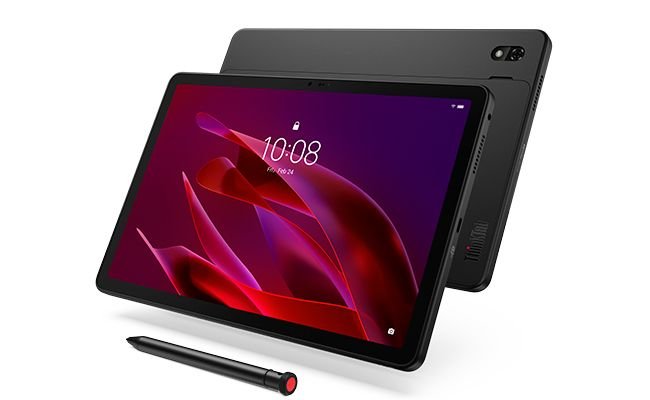
In an era where user-replaceable batteries 🔋 have virtually vanished from the tablet market 📱, Lenovo is bucking the trend with its latest Android release. 🚀 First unveiled at MWC 2026 🌐, the Lenovo ThinkTab X11 has officially launched in the US 🇺🇸, bringing a unique blend of rugged durability 💪 and business-ready features 💼 to the mid-range segment.
Under the hood ⚙️, the ThinkTab X11 sports a crisp 10.95-inch WQXGA (2560 x 1600) display 🖥️ that boasts a smooth 90Hz refresh rate ⚡ and peaks at a bright 600 nits ☀️. It is powered by Qualcomm’s capable Snapdragon 7s Gen 3 chipset 🧠, configured with up to 8GB of LPDDR5 RAM and up to 256GB of fast UFS 3.1 storage 💾. Out of the box, the tablet runs Android 16 🤖, backed by Lenovo’s promise of at least four years of security patches 🛡️.
What truly sets the ThinkTab X11 apart from its peers, however, is its commitment to longevity and field-readiness 🌟. Its massive 10,200mAh battery 🔋 can be swapped out entirely tool-free—no screwdrivers required 🛠️. For specialized industrial or kiosk setups 🏭, Lenovo even includes a battery-less power mode 🔌. The tablet itself is IP68-rated against dust and water 💦💨, and pairing it with the optional rugged case upgrades its resilience to MIL-STD-810H military-grade standards 🪖.
Connectivity is another strong suit 🔗, featuring dual USB 3.2 Gen 1 Type-C ports 🔌 (one of which supports video out 📺). In a welcome nod to legacy convenience, Lenovo has kept both the 3.5mm headphone jack 🎧 and a microSD card slot 💾—two features that have almost entirely disappeared from modern high-end tablets. Rounding out the spec sheet are Wi-Fi 6E 📶, Bluetooth 5.4 📡, GPS 🧭, NFC, stereo speakers 🔊, dual microphones 🎙️, a 13MP autofocus rear camera 📸, and an 8MP front-facing camera 🤳.
Available in a sleek Eclipse Black finish 🖤, the ThinkTab X11 starts at $499 💵 in the US for the Wi-Fi-only model equipped with 8GB of RAM and 128GB of storage. Users needing mobile connectivity can opt for the 5G variant 📶, which bumps the storage to 256GB for $579. Additionally, the tablet supports the Lenovo Tab Pen XE stylus ✍️, which conveniently slots right into the optional rugged protective case 🛡️.

Realme is about to change the game 🎮 with a massive 8,000mAh battery beast! 🔋🦁 The all-new Realme P4R 5G is officially launching on June 10, 📅 packing a 3-day battery life, ⏳ 144Hz display, 📺 and military-grade durability. 🎖️ Get the full scoop on specs, features, and design right here. 📝
Realme P4R 5G launch date and key features 🚀📱
#Realme
Realme P4R is launching on June 10 in India 🇮🇳📅
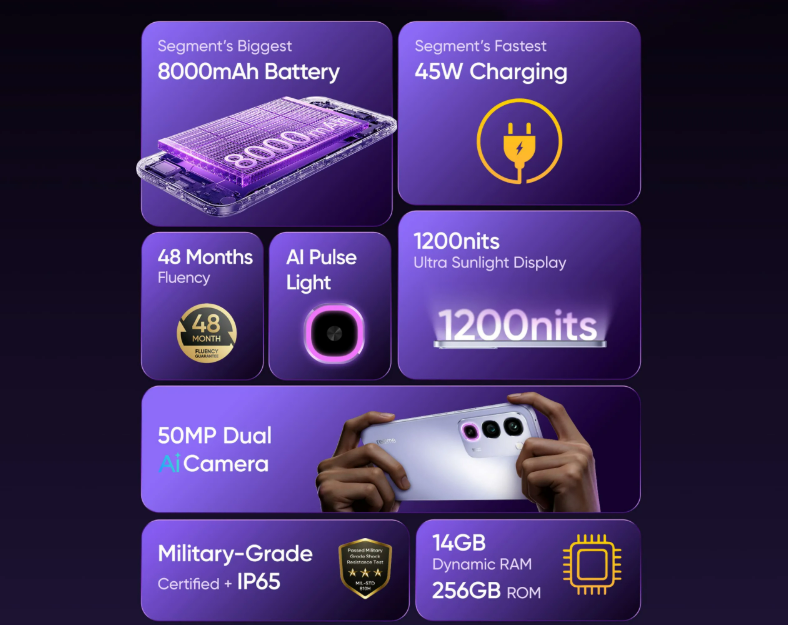
The Realme P4R 5G will launch in India on June 10 at 12pm IST. 🕛 The smartphone will be offered in Titanium Glare, Silver Glare, and Lavender Glare colour options. 🎨✨ It introduces a new Floating Light design along with a customizable Pulse Light and AI Power Light system that can provide visual notifications for calls, music playback, gaming activities, and alerts. 💡📞🎶🎮
One of the biggest highlights of the handset is its 8,000mAh battery. 🔋 Realme claims the battery can deliver up to three days of usage on a single charge. ⏳ The phone supports 45W fast charging ⚡ and includes features such as bypass charging, reverse charging, AI-powered power management, and a battery health engine that is said to maintain more than 80 percent battery health after several years of use. 🛠️ Hearty cooling is provided by a 5,300 sq mm vapor chamber system to help manage heat during demanding tasks. ❄️🌬️
Realme P4R key features 📝✨
The Realme P4R 5G is powered by the MediaTek Dimensity 6300 chipset ⚙️ and will run Android 16-based Realme UI 7.0. 🤖 The handset is confirmed to offer 256GB of storage and up to 14GB Dynamic RAM. 💾🚀 It also carries MIL-STD-810H military-grade durability certification and an IP65 rating for dust and water resistance. 🛡️💧
For visuals, the smartphone features a flat display with a 144Hz refresh rate 📺 and up to 1,200 nits peak brightness for improved outdoor visibility. ☀️ Photography duties are handled by a dual rear camera setup led by a 50-megapixel AI camera. 📸 For durability, the smartphone will have a military-grade certified body along with an IP65 level of dust and splash resistance. 🎖️🛡️
Tablet
May AnTuTu Android-Pad Performance Ranking: Snapdragon 8 Elite Gen 5 sweeps top six spots 🧹🏆, Dimensity 9500 lands at No. 7 📅
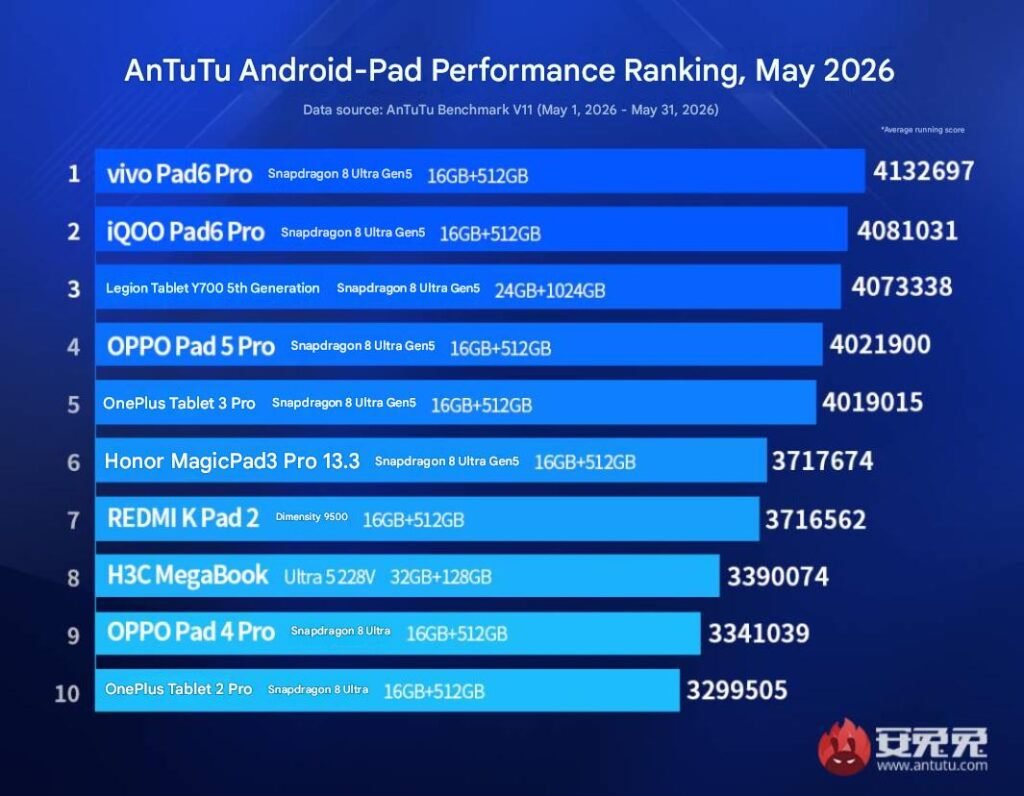
The tablet performance war just reached a new peak ⚔️📈. With scores shattering the 4-million-point barrier 💥, the May 2026 AnTuTu rankings reveal a new king—and the results might surprise you 👑😲.
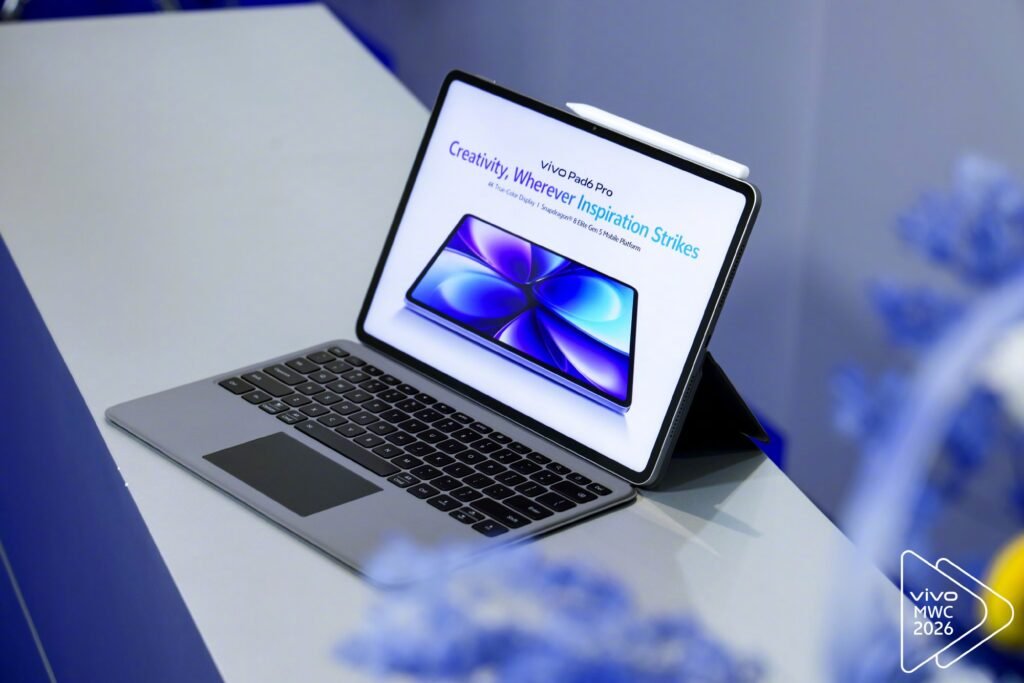
Leading the chart is the Vivo Pad 6 Pro 🥇, which posted an average score of 4,132,697 points 🚀. Powered by Qualcomm’s Snapdragon 8 Elite Gen 5 🔌, it currently sits at the top of the Android tablet performance ladder 🪜.
The iQOO Pad 6 Pro isn’t far behind at 4,081,031 points 🥈. Given how much hardware the two tablets share, the small gap between them isn’t particularly surprising 👯♂️.
#Antutu Performance
Lenovo’s Legion Y700 5th Gen takes third place with 4,073,338 points 🥉. The compact gaming tablet has built a strong reputation among enthusiasts 🎮, and these numbers suggest Lenovo has another winner on its hands 🔥.
A quick look at the rest of the top ten reveals a clear trend 📊: Snapdragon 8 Elite Gen 5 is everywhere 🌎. The Oppo Pad 5 Pro, OnePlus Pad 3 Pro, and Honor MagicPad 3 Pro 13.3 all make appearances near the top of the list, underlining Qualcomm’s grip on the flagship tablet market right now ✊.
One of the more interesting entries is the Redmi K Pad 2 🤔. It’s the only device in the top ten running MediaTek’s Dimensity 9500 🦄, yet it still manages an average score of 3,716,562 points, which is enough to keep it firmly in the mix 💪.
Further down the rankings are devices like the H3C MegaBook with Intel’s Core Ultra 5 228V 💻, along with older Snapdragon-powered tablets such as the Oppo Pad 4 Pro and OnePlus Pad 2 Pro 📉.
Benchmark charts never tell the whole story 📖, but they do offer a snapshot of where the market stands 📸. At least for now, Snapdragon 8 Elite Gen 5 devices are setting the pace 🏃💨, with the Vivo Pad 6 Pro holding a narrow lead over an increasingly crowded field 🏁.
Don’t miss a thing! 🔔 Join our Telegram community for instant updates ✈️ and grab our free daily newsletter for the best tech stories! 📩🗞️

JBL Live 780NC and Live 680NC Debut 🎉 in India: Featuring True Adaptive ANC, Spatial Audio, and Up to 80 Hours of Battery Life 🔋

Vivo X Fold 6 Set to Redefine Foldables with a 7,000mAh Battery 🔋 and IPX8/IPX9 Durability 🛡️

Why Next-Gen AI Smartphones May Ditch LPDDR for LLW 🪐

The final 6 ‘Game of Thrones’ Trailer

The old and New Edition cast comes together to perform

Phillies’ Aaron Altherr makes mind-boggling barehanded play

Vivo X Fold 6 with Dimensity 9500 ⚙️, 200MP triple cameras to launch by June end 🚀

Marvel Tōkon: Fighting Souls 🥊 arrives on PS5 and PC 🎮 this August 6, bringing the X-Men ❌ along for the ride.

Samsung Galaxy Unpacked 2026 📅: The Galaxy S26 series ✨,
-
 Entertainment9 years ago
The final 6 ‘Game of Thrones’ Trailer
-
 Entertainment9 years ago
The old and New Edition cast comes together to perform
-
 Buying9 years ago
Phillies’ Aaron Altherr makes mind-boggling barehanded play
-

 Videos9 years ago
Uber and Lyft are finally available in all of New York State
-

 Entertainment9 years ago
Disney’s live-action Aladdin finally finds its stars
-

 Buying9 years ago
Steph Curry finally got the contract he deserves from the Warriors
-

 Videos6 months ago
Pixar’s Win or Lose debuts first episode for free on YouTube 🎬 🏆 🆓
-

 Entertainment9 years ago
From ‘Dick Clark’s New Year’s Rockin’ Eve’ 🎸 to ‘Nashville’s Big Bash,’ 🤠